Find Your Current Zip Code
Perfect for travelers and remote locations. Click the button below to detect your postal code.
Safe, fast, and private location detection.
Finding your ZIP (postal) code is fast and easy with our WhatIsMyZipcode tool. It automatically detects your location in seconds and shows the correct ZIP (or postal) code for your area, which you can copy for any purpose.
This article explains how to use the tool step-by-step, highlights 8 practical use cases for knowing your ZIP code, and provides background on postal code systems (US vs. international).
We also cover privacy – our tool runs entirely in your browser, so no personal data is collected or stored – and offer on-page SEO recommendations (focus keywords, meta tags, etc.) for search optimization.
Finally, there’s a helpful FAQ section and a printable Emergency ZIP Code Checklist. Use this content to inform your site visitors, boost SEO, and help them make the most of your ZIP code lookup tool.
How to Use the ZIP Code Lookup Tool
Using the tool is straightforward:
- Visit the Page: Go to the WhatIsMyZipcode tool page. The page will prompt you to allow location access.
- Allow Location Access: Approve the browser popup so the tool can determine your location. This is done with client-side code (no data is sent to servers).
- Tool Finds Your Location: The tool uses either your device’s geolocation (GPS/Wi-Fi) or your IP address to find your latitude and longitude.
- ZIP Code Lookup: It then converts that location into a ZIP/postal code (using a lookup database). For example, detecting (40.7128, -74.0060) would yield ZIP 10001 (Manhattan, NY).
- Display and Copy: Your ZIP code is displayed on screen. You can copy it or use it as needed (e.g. paste it into a form, share with emergency services, etc.).
Below is a simple flowchart of how it works:
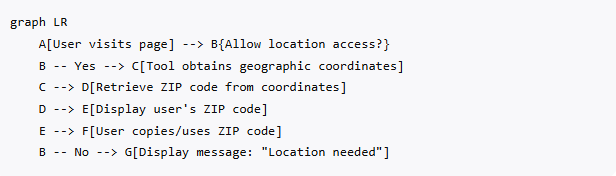
Flowchart showing steps: user visits page, allows location, tool finds coordinates, retrieves ZIP code, and displays it for user.
8 Practical Use Cases for ZIP Codes
Knowing your exact ZIP/postal code is useful in many everyday scenarios. Here are 8 real-world examples:
- Emergency Services: When calling 911 or emergency responders, giving your ZIP code (along with address) helps pinpoint your location quickly. In disasters, officials often deliver alerts or aid by ZIP area.
- Shipping & Delivery: Couriers and online stores require ZIP codes to calculate shipping costs and ensure packages arrive correctly. Entering the right ZIP avoids delays or returned mail.
- Online Forms & Registration: Many forms auto-fill your city/state from your ZIP code. Correct ZIP ensures you get accurate information and confirmations (e.g. taxes, school district, or healthcare providers).
- Weather Alerts: Weather forecasts and alerts (tornadoes, hurricanes, etc.) are often issued by ZIP code. Signing up for local emergency alerts requires your ZIP.
- Local Services & Businesses: Websites use your ZIP to show nearby stores, restaurants, hospitals, and service providers. For example, searching “pharmacy near me” will use your ZIP to list the closest options.
- Voting & Government Services: Voter registration lookup and polling locations are tied to your ZIP code. Local government notices (like new districting or taxes) are sent by ZIP.
- Travel Planning: When booking travel, apps may ask for your ZIP to calculate distances, gas prices, or travel times from your home area. It also helps maps apps route you more accurately.
- Marketing & Analysis: Businesses analyze customer demographics by ZIP code. While not an everyday use for a typical user, researchers and marketers match ZIP data to population info (age, income, etc.).
These use cases show how a simple 5–10 digit code can connect you to the right local information. Always double-check your ZIP when filling forms or contacting services.
How ZIP and Postal Codes Work (US vs. Global)
A ZIP code is the postal code system used by the United States Postal Service (USPS). “ZIP” stands for Zone Improvement Plan. The system was introduced in 1963 to speed up mail sorting by assigning codes.
A standard US ZIP code is 5 digits: the first digit designates a broad region, the next two narrow it to a central mail facility, and the last two pinpoint a local post office or area. An extended “ZIP+4” code adds four more digits (e.g. 12345-6789) to identify a specific block or building.
Globally, each country uses its own postal code system. Some examples:
- United States: 5-digit numeric (ZIP) or ZIP+4 (e.g., 10001 or 10001-0002).
- United Kingdom: Complex alphanumeric (e.g., SW1A 1AA) that pinpoints individual streets or parts of streets.
- Canada: Six characters alternating letter-number (e.g., M5V 2T6).
- Germany: 5-digit numeric (e.g., 10115).
- France: 5-digit numeric (e.g., 75001 for Paris).
- India: 6-digit numeric (PIN code) grouping regions.
- Hong Kong: No postal codes – the system relies on district and building for sorting.
- Japan: 7-digit numeric, often written as 123-4567.
- Australia: 4-digit numeric (e.g., 2000 for Sydney CBD).
In general, postal codes are a series of letters and/or numbers designed to streamline mail sorting worldwide. The exact format and name vary: some countries call them PIN codes (India), CAP (Italy), Postleitzahl or PLZ (Germany), CEP (Brazil), etc. The U.S. ZIP code concept was so influential that it inspired postal systems globally. The key point is that nearly every country’s mail system uses postal codes in some form, but formats differ widely.
| Country | Format | Example | Notes |
|---|---|---|---|
| United States (US) | 5-digit (ZIP) (optional +4) |
10001 | “ZIP” introduced 1963 |
| United Kingdom (UK) |
Alphanumeric |
SW1A 1AA | Mix of letters/numbers |
| Canada | A#A #A# | M5V 2T6 | Letter-number pattern |
| Germany | 5-digit | 10115 | First digit 0–9 by region |
| India | 6-digit (PIN) | 110001 | Postal Index Number |
| Hong Kong | (none) | – | No postal code system |
| Australia | 4-digit | 2000 | Geographic by region |
| Japan | 7-digit | 123-4567 | (Often with hyphen) |
Table comparing postal code formats in various countries (US uses 5-digit numeric, UK uses alphanumeric, etc.).
Key Takeaway: Different countries have different postal code formats. Knowing your local format ensures you use the tool correctly and understand returned results. For example, if you live in the UK, the tool may display an alphanumeric code (your postcode), whereas in the US it will show a 5-digit ZIP.
Privacy and Data Use Notice
Important: Our ZIP code tool is 100% privacy-friendly. It works entirely in your browser:
-
Client-Side Lookup: The tool only runs on your device. It asks your browser for location, converts that to a ZIP code, and shows it to you. No server stores your location or IP.
-
No Tracking or Storage: We do not save or log your IP address, coordinates, or any personal information. The lookup is one-time and in-browser.
-
No Third-Party Sharing: We don’t send your data to advertisers or any external services. It’s fully self-contained.
-
Geolocation Only (Optional): You can choose not to allow GPS location. In that case, the tool may use your approximate IP location. But again, nothing is stored or shared.
-
Recommended Wording: We suggest a short footer notice like:
“Privacy: This tool runs in your browser only. No personal data or location info is saved or shared. Your ZIP code is found on the fly and not recorded. It’s just between you and your device.”
Because our tool is simple and client-based, it complies with privacy best practices (no cookies, no tracking pixels). Feel safe using it on any device.
Frequently Asked Questions
-
How does the tool find my ZIP code?
The tool uses your device’s location (GPS/Wi-Fi) or IP address to get coordinates. It then looks up those coordinates in a postal code database to find the matching ZIP or postal code for your area. The result appears instantly on screen. -
Do I have to allow location access?
For best accuracy, allow the browser prompt to share your location. This is done on the client side only. If you decline, the tool may try using your IP address, which is less precise. No matter what, no personal data is stored – it’s just used temporarily to get your code. -
Can I use this outside the United States?
Yes. Our tool will display the appropriate postal code for your country. If you’re in the UK, Canada, Australia, etc., it shows your local postal code format. (Note: In places like Hong Kong with no postal code, it may simply show your locality.) -
How accurate is the ZIP code provided?
It’s generally exact for your current location, since GPS or IP lookups are quite precise. However, on rare occasions (like if you’re near a city border or using a VPN), it may show the nearest post office’s code. We always recommend double-checking if exact accuracy is critical. -
Is my data shared or saved?
No. This tool is privacy-focused. We do not save your IP address, coordinates, or any personal info. As soon as your ZIP code is shown on the screen, the process is finished. No cookies or tracking of any kind are used.
Printable Emergency ZIP Code Checklist
Keep this quick checklist handy in case of emergencies. It’s wise to know and use your ZIP code when needed:
- Memorize Your ZIP Code: Make sure you and your family know your area’s ZIP code by heart (especially important for children and seniors).
- Program Emergency Alerts: Register for local emergency alerts (weather, AMBER, etc.) using your ZIP code.
- Share Location Wisely: If calling emergency services (911), clearly state your address and ZIP code to speed up response.
- Home Safety Kit: Write your ZIP code on a contact list or emergency card in your home safety kit.
- Map Your Area: Keep a list of key locations (hospitals, police stations) by ZIP code for quick reference.
- Inform Neighbors: During evacuations, check in with neighbors (especially those who are vulnerable) and share your ZIP to ensure everyone gets correct instructions.
- Plan Routes: Know evacuation routes in your ZIP code zone and keep maps in your car.
- Backup Contacts: Store important contacts with ZIP codes included (e.g., “Nearest friend in 94107: John Doe”).
Emergency Ready: Having your ZIP code on hand can save crucial minutes. Tuck this list with your emergency supplies or print it out as a reminder.
Appendix: Printable Templates
52/17 Daily Schedule Template
Click here to download a FREE planner. Use the fillable template to plan your day in 52-minute work sprints with 17-minute breaks. Adjust times as needed.
Workspace Optimization Checklist
Before starting any focus session, optimize your workspace with these steps:
- Clear Clutter: Remove unnecessary items from your desk. Only keep what you need for the task.
- Control Noise: Use headphones or quiet background music. Silence notifications on phone/computer.
- Adjust Lighting: Use natural light if possible or a soft desk lamp. Eliminate glare on screens.
- Check Ergonomics: Make sure your chair and screen are at comfortable height. Sit with good posture.
- Add Inspiration: Place a motivating quote or a small plant in view to stay positive.
- Quick Reset: Before each session, take 1 minute to tidy your desk and stretch so you start focused.
By using this checklist daily, your environment will support concentration and reduce distractions, making each 52-minute focus session more productive.